Think of a blockchain like a shared spreadsheet that nobody owns: a powerful idea that began with Bitcoin. If you've ever wondered how Bitcoin actually moves from one wallet to another, or how it maintains its value without a central authority, this article will walk you through the fundamental concepts. We'll explore the ingenious combination of a public record and advanced cryptography that makes digital currencies possible.
Disclaimer: This article is for informational purposes only and does not constitute financial advice. Always conduct your own research before making any financial decision.
What Is Bitcoin?
Bitcoin is a fully digital form of money, distinct from traditional currencies because no government issues it and no bank manages its accounts or verifies transactions. It was the first widely adopted cryptocurrency, a type of digital money that combines a public record of payments with cryptographic techniques to remove the need for trusted financial institutions. Instead of relying on a bank to keep track, Bitcoin's entire history of transactions is maintained on a shared, public record that everyone can see and verify.
Imagine a communal record book that everyone keeps a copy of, where every payment ever made is written down. This record book, which is public and allows anyone to add new lines, is called a ledger. In the world of Bitcoin, this collective history of transactions itself is what constitutes the currency.
How Does Bitcoin Work?
Bitcoin operates on a clever system designed to allow people to send and receive digital money without a central bank or institution. At its core, it's about everyone agreeing on the correct history of transactions. This agreement is achieved through a combination of public record-keeping and advanced mathematics.
Here's how it generally functions:
- Transactions Begin: When you want to send Bitcoin to someone, you first create a transaction request. This message states who is sending what amount to whom.
- Digital Signature: To prove that you, and only you, approved this transaction, you create a digital signature.
Digital Signature: A cryptographic method that proves a user has seen and approved a specific transaction, making it extremely difficult for anyone else to forge. This signature is generated using your private key. Private Key: A secret string of bits that only you know and use to create digital signatures for your transactions. Along with this, you also have a public key, which is shared with others. Public Key: A string of bits associated with your private key, used by others to verify that your digital signature is authentic.The digital signature changes for every transaction and is unique to your private key and the specific transaction details, making it impossible to copy and reuse for a different payment.
- Broadcasting Transactions: Once signed, your transaction is broadcast across the Bitcoin network for other participants to see.
- Collecting Transactions into Blocks: Individuals or groups known as miners listen for these broadcasted transactions.
Miner: An individual or group that collects new transactions, groups them into a block, and performs computational work to add that block to the blockchain, earning a reward. Miners gather a collection of recent transactions into a single unit called a block. Block: A unit containing a list of new transactions, a proof of work, and a reference to the previous block's hash, forming part of the blockchain.
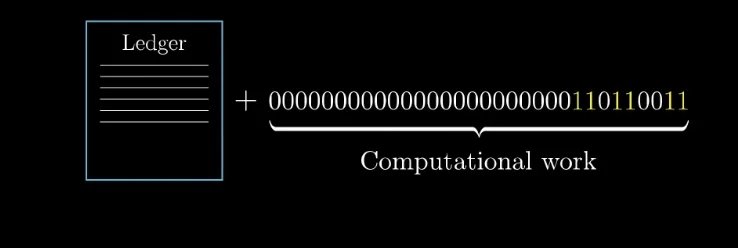
- Solving the Proof of Work Puzzle: Before a block can be added to the shared ledger, a miner must solve a difficult computational puzzle. This process is called Proof of Work.
Proof of Work: A mechanism requiring miners to expend significant computational effort to solve a difficult puzzle, proving they've done "work" to secure the network and discouraging fraud. Miners essentially guess a special number that, when combined with the block's data and run through a cryptographic hash function, produces an output (a "hash") that meets specific criteria (e.g., starts with many zeros). Cryptographic Hash Function: A mathematical function that takes any input data and produces a fixed-length string of seemingly random characters (a "hash" or "digest"). It's easy to compute in one direction but extremely difficult to reverse-engineer the input from the output. This guessing game requires immense computing power, and it's designed to take, on average, about ten minutes for someone on the network to find the correct number. The difficulty of this puzzle automatically adjusts as more or fewer miners join the network, aiming to keep this 10-minute target.
- Broadcasting the New Block: The first miner to find the correct number broadcasts their newly "solved" block to the entire network.
- Adding to the Blockchain: This new block, which includes a block reward for the successful miner, is then added to the end of the existing chain of blocks.
Block Reward: A special amount of new Bitcoin generated and given to the miner who successfully adds a new block to the blockchain, creating new currency. This continuous chain of blocks is called the blockchain. Block Chain: A distributed, public ledger composed of individual blocks, where each block is linked to the previous one using its cryptographic hash, ensuring the integrity and chronological order of all transactions.
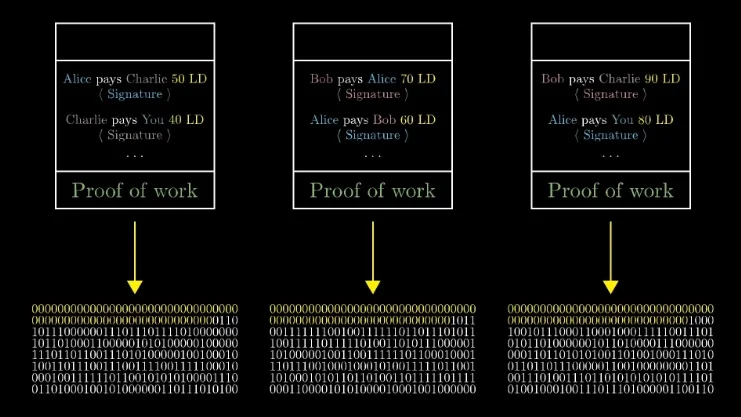
- Network Consensus: Everyone on the Bitcoin network keeps their own copy of the blockchain. When there are competing versions, the protocol dictates that everyone trusts the "longest" blockchain – the one that has had the most computational work put into it. This ensures that the network always converges on a single, agreed-upon history of transactions without a central authority.
A key economic feature of Bitcoin is its limited supply. The total number of Bitcoin that will ever exist is capped at 21 million units. The block reward that miners receive is cut in half approximately every four years (or every 210,000 blocks), meaning new Bitcoin enters the system at a decreasing rate until the cap is reached. Once the block rewards diminish significantly, miners are incentivized by transaction fees that users can optionally include with their payments to ensure their transactions are prioritized.
Why Does Bitcoin Matter?
Bitcoin introduces a fundamentally different way to manage and transfer value, solving key problems inherent in traditional financial systems. Bitcoin's importance stems from its ability to operate without relying on trust in any single organization or government.
At its core, Bitcoin removes the need for trusted intermediaries like banks or financial institutions to manage your money or verify your transactions. Instead of a central entity controlling the ledger, the Bitcoin network uses a combination of public record-keeping and cryptography to achieve decentralized trustless verification. This means that the integrity of the system is maintained by mathematical proofs and the collective effort of the network, rather than by a single authority.
This decentralized approach provides a public and communal record of payments that is accessible to anyone. It solves the problem of how a group of people can agree on a shared history of transactions, and thus who owns what, without needing to trust a central controller. In a world without Bitcoin's underlying technology, all digital transactions would inherently rely on some form of central authority. Bitcoin offers an alternative where consensus is achieved through computational work and a transparent, verifiable history. 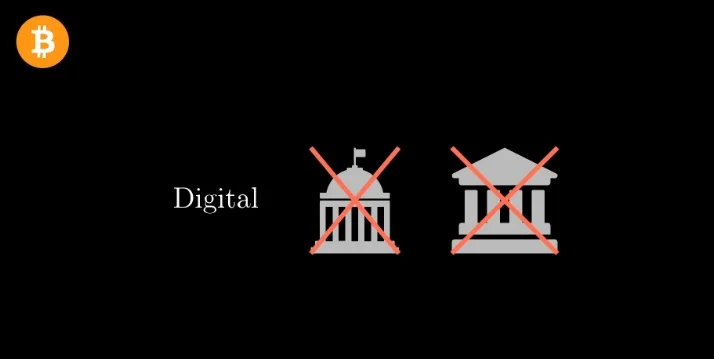
Key Terms You Should Know
Term | Plain-English Meaning |
|---|---|
Bitcoin | A fully digital currency operating without a central government or bank, based on a decentralized network and cryptographic principles. |
Ledger | A public, communal, and verifiable record of payments between different parties, similar to a digital accounting book. |
Cryptocurrency | A digital currency that uses cryptography to secure and verify transactions, and to control the creation of new units, operating independently of a central bank. |
Digital Signature | A cryptographic proof that a user has seen and approved a specific transaction, which is computationally impossible to forge. |
Private Key | A secret code (string of bits) that only the owner knows and uses to authorize their transactions by creating digital signatures. |
Public Key | A code (string of bits) derived from a private key, which is shared publicly and used by others to verify the authenticity of a digital signature. |
Block | A package of new, verified transactions, along with a "proof of work" and a link to the previous block, forming part of the blockchain. |
Block Chain | A distributed, shared, and public ledger where new blocks of transactions are cryptographically linked together in chronological order. |
Proof of Work | A system where miners must solve a difficult computational puzzle to add a new block, requiring significant effort and securing the network against fraud. |
Cryptographic Hash Function | A mathematical function that converts any input into a fixed-length, seemingly random output. It's easy to compute forward but impossible to reverse. |
Miner | A participant in the network who collects transactions, creates new blocks, performs the "proof of work" to validate them, and earns new Bitcoin as a reward. |
Block Reward | The new Bitcoin created and awarded to a miner for successfully adding a new block to the blockchain, introducing new currency into the system. |
Transaction Fee | An optional small payment included by a user with their transaction, paid to the miner who includes that transaction in a block, incentivizing its processing. |
Common Misconceptions
- You need to understand complex technical details to use Bitcoin.Correction: Just like you don't need to know how a credit card works under the hood to swipe it, user-friendly applications exist that allow you to send and receive Bitcoin without understanding its intricate technical backbone.
- A new block is immediately trustworthy once it's broadcast.Correction: It's generally recommended to wait for several additional blocks to be added on top of a new block before fully trusting a transaction within it. This waiting period helps ensure that the block is part of the longest, most widely accepted chain on the network.
- Bitcoin is directly tied to the value of traditional currencies like the US dollar.Correction: Bitcoin is its own independent currency. While it can be exchanged for traditional currencies on open markets, its value is not guaranteed by any government or bank, and it functions as a distinct economic system.
- New Bitcoin is created when people buy it with cash.Correction: New Bitcoin enters the system through block rewards given to miners who successfully add new blocks to the blockchain. This process is a fundamental part of how new currency is introduced, separate from buying and selling existing Bitcoin.
Frequently Asked Questions
Is Bitcoin safe?
Bitcoin's security relies on the immense computational effort required for Proof of Work and the network's consensus mechanism, which always favors the blockchain with the most work. This makes it computationally infeasible for a single entity to forge transactions or create a fraudulent history. However, the security of your Bitcoin also depends on how you manage your private key, as losing it means losing access to your funds.
Do I need to understand all the technical details to use Bitcoin?
No, you do not. While understanding the underlying technology can be insightful, using Bitcoin for everyday transactions is much like using any other digital payment system. Many user-friendly applications and services allow you to send, receive, and manage Bitcoin without needing to grasp every technical aspect.
How is Bitcoin different from traditional money?
Bitcoin differs from traditional money primarily because it operates without a central issuing authority like a government or central bank. There's no single entity to manage accounts, verify transactions, or control its supply. Instead, it relies on a decentralized, public ledger and cryptographic principles for security and consensus. Traditional money typically involves intermediaries like banks for all transactions.
Can anyone use Bitcoin?
Yes, the Bitcoin network is open to anyone. Individuals can download software to become part of the network, listen for transactions and blocks, and verify the blockchain. Anyone can also choose to become a miner and contribute computing power to help secure the network, potentially earning block rewards.
Where does new Bitcoin come from?
New Bitcoin is generated as block rewards for miners who successfully validate and add new blocks of transactions to the blockchain. This process is part of Bitcoin's built-in monetary policy, which controls the rate at which new Bitcoin enters circulation.
Is there a limit to how much Bitcoin there will ever be?
Yes, there is a strict limit. The total supply of Bitcoin is capped at 21 million units. This limit is enforced by the protocol, which geometrically reduces the block reward over time, ensuring a finite number of Bitcoin can ever be created.