Bitcoin vs Ethereum: Platform Purpose and Consensus Mechanisms
Feature Bitcoin Ethereum
Launch Year | 2009 | 2015 |
Primary Purpose | Store and exchange Bitcoin cryptocurrency | Host various digital assets (e.g., Ether, dApps, NFTs) |
Consensus Mechanism | Proof-of-Work | Proof-of-Stake |
Block Confirmation Time | 10 minutes | 12 seconds |
Supply Limit | 21 million maximum | No overall maximum; 18 million annual maximum |
Disclaimer: This article is for informational purposes only and does not constitute financial advice. Always conduct your own research before making any financial decision.
What Is Bitcoin?
Bitcoin's Lightning Network operates on a simple premise: Bitcoin is a cryptocurrency that operates on a blockchain-based network. The Bitcoin platform is specifically engineered to store and facilitate the exchange of its native cryptocurrency, Bitcoin.
Bitcoin was developed in 2009. Its foundational mechanism involves a competition-based proof-of-work consensus system to verify transactions on its network. This system underpins its operational integrity.
What Is Ethereum?
Most staking systems share three core components: Ethereum is a blockchain-based network designed to host various digital assets. Beyond cryptocurrencies, it supports executable code, decentralised applications (dApps), decentralised financial contracts (DeFi), and non-fungible tokens (NFTs).
Created in 2015, Ethereum has its own native cryptocurrency known as Ether. Its consensus mechanism employs a proof-of-stake system, which requires users to stake 32 Ether tokens to function as validators on the network.
History and Development Compared

Dimension Bitcoin Ethereum
Launch Year | 2009 | 2015 |
Bitcoin commenced operations in 2009, establishing itself as an early blockchain implementation. Ethereum followed six years later, with its creation in 2015.
Platform Purpose Compared

Dimension Bitcoin Ethereum
Primary Function | Store and exchange Bitcoin cryptocurrency | Host various digital assets, dApps, DeFi, NFTs |
Native Cryptocurrency | Bitcoin | Ether |
Bitcoin's platform is structured for the singular purpose of managing and transacting the Bitcoin cryptocurrency. Ethereum, conversely, functions as a general-purpose blockchain, supporting a broader array of digital assets including cryptocurrencies, smart contracts, and decentralised applications.
Consensus Mechanism Compared
Dimension Bitcoin Ethereum
Mechanism Type | Proof-of-Work | Proof-of-Stake |
Validation Requirement | Competition-based computation | Staking 32 Ether tokens |
The difference between proof-of-work and proof-of-stake comes down to one mechanism: Bitcoin implements a competition-based proof-of-work system for transaction verification. Ethereum employs a proof-of-stake consensus mechanism, which mandates that users stake 32 Ether tokens to assume the role of network validators.
Speed and Performance Compared

Dimension Bitcoin Ethereum
Block Confirmation Time | 10 minutes | 12 seconds |
Bitcoin blocks require a 10-minute interval for confirmation on its network. Ethereum blocks are confirmed significantly faster, with a duration of 12 seconds.
Supply Limits Compared
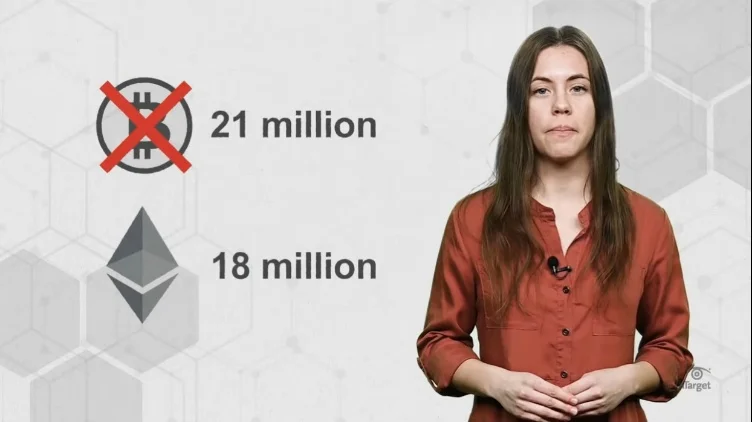
Dimension Bitcoin Ethereum
Maximum Supply | 21 million total | No overall maximum, 18 million annual maximum |
Bitcoin is structured with a hard cap, possessing a maximum block supply limit of 21 million units. Ethereum does not have an overarching maximum supply of Ether but operates with an annual maximum supply of 18 million Ether.
Who Should Use Bitcoin?
- Users focused exclusively on the storage and exchange of a single, foundational cryptocurrency.
- Entities prioritizing a network built upon a competition-based proof-of-work consensus model.
Who Should Use Ethereum?
- Developers and users engaged with decentralised applications, smart contracts, and non-fungible tokens.
- Individuals interested in a blockchain platform supporting a diverse range of digital assets beyond a single cryptocurrency.
- Participants who prefer a proof-of-stake consensus mechanism for network validation.
Side-by-Side Summary
Dimension Bitcoin Ethereum
Blockchain Type | Cryptocurrency-specific | General-purpose, multi-asset |
Launch Year | 2009 | 2015 |
Primary Function | Store and exchange Bitcoin | Host Ether, dApps, DeFi, NFTs |
Consensus Mechanism | Proof-of-Work | Proof-of-Stake |
Block Time | 10 minutes | 12 seconds |
Total Supply Limit | 21 million | No overall maximum |
Annual Supply Limit | N/A | 18 million |
Frequently Asked Questions
Is Bitcoin better than Ethereum?
Neither platform is inherently 'better'; suitability depends on the user's specific requirements. Bitcoin is designed for secure, decentralised currency transactions, while Ethereum offers a broader platform for smart contracts and decentralised applications.
Which is safer — Bitcoin or Ethereum?
Both Bitcoin and Ethereum employ robust blockchain security mechanisms, though their consensus models differ. Bitcoin uses proof-of-work, and Ethereum uses proof-of-stake. The security of each system is inherent to its design and operational protocols.
Can I use both Bitcoin and Ethereum?
Yes, both platforms serve distinct functions within the digital asset ecosystem. Users can interact with Bitcoin for its native cryptocurrency transactions and simultaneously utilize Ethereum for its broader smart contract and dApp functionalities.
How do their consensus mechanisms differ?
Bitcoin's consensus mechanism is proof-of-work, requiring computational competition to validate transactions. Ethereum uses a proof-of-stake mechanism, where users stake 32 Ether tokens to become validators and secure the network.