Bitcoin vs Bitcoin SV: Quick Comparison
Feature | Bitcoin | Bitcoin SV |
|---|---|---|
OP_RETURN Limit | 40-80 bytes | 100 kilobytes (100,000 bytes) |
Data Filtration | Built-in configurable filter (e.g., Bitcoin Knots) | No mention of filtration; higher limit enabled illicit storage |
Illicit Content Risk | Lower risk due to limits and filtration | Allowed illicit content to be stored |
Immutability of Illicit Content | Lower risk of permanent storage due to limits/filtration | Illicit content remains permanently hosted due to immutability |
Disclaimer: This article is for informational purposes only and does not constitute financial advice. Always conduct your own research before making any financial decision.
What Is Bitcoin?
Bitcoin is the world's first and largest cryptocurrency by market capitalisation, created in 2009 by the pseudonymous Satoshi Nakamoto. It operates on a decentralised peer-to-peer network secured by Proof of Work consensus, with a fixed maximum supply of 21 million coins.
Bitcoin is widely used as a store of value, a medium of exchange, and a hedge against inflation by individuals and institutions worldwide. Its node implementations include a built-in filter that allows users to configure parameters for what data is relayed into the mempool.
decentralised peer-to-peer network: A network where participants interact directly with each other without the need for a central authority or intermediary. Proof of Work: A consensus mechanism used to validate transactions and create new blocks on a blockchain, requiring participants to solve complex computational puzzles. fixed maximum supply: A predetermined, unchangeable upper limit on the total number of coins that can ever exist for a cryptocurrency. store of value: An asset that maintains its purchasing power over time without depreciating. medium of exchange: An intermediary instrument used to facilitate the sale, purchase, or exchange of goods and services. hedge against inflation: An investment intended to protect the investor from a decrease in the purchasing power of money due to rising prices.
What Is Bitcoin SV?
Bitcoin SV is a blockchain that significantly increased its OP_RETURN limit compared to Bitcoin. This alteration to the protocol parameter allows for substantially larger amounts of data to be stored directly on its blockchain.
This increased data capacity has specific implications for the type of content that can be hosted. Notably, the increase of the OP_RETURN limit on the Bitcoin SV blockchain allowed for illicit material to be stored permanently due to the blockchain's immutable nature.
Data Storage Limits Compared
Feature | Bitcoin | Bitcoin SV |
|---|---|---|
OP_RETURN Limit | 40 bytes (introduced 2014), later increased to 80 bytes | 100 kilobytes (100,000 bytes) |
The OP_RETURN limit on Bitcoin Core was initially 40 bytes in 2014 and was later increased to 80 bytes. In contrast, Bitcoin SV increased its OP_RETURN limit considerably to 100 kilobytes of data. This difference dictates the maximum amount of arbitrary data that can be stored in a transaction output on each blockchain.
Data Filtration and Immutability Compared
Feature | Bitcoin | Bitcoin SV |
|---|---|---|
Data Filtration | Built-in filter for mempool data, configurable by users | No mention of built-in data filtration capabilities |
Illicit Content Potential | Lower risk due to smaller data limits and filtration | Allowed illicit material to be stored due to high data limit |
Immutability of Illicit Content | Content filtered at node level, reducing risk of permanent illicit storage | Illicit content stored through exploit remains permanently hosted |
Bitcoin has a built-in filter in its node implementation, allowing users to configure parameters for data relayed into the mempool. Implementations like Bitcoin Knots, which approximately 18% of active Bitcoin nodes run, offer added configurability for mempool filtration.  The increased OP_RETURN limit on Bitcoin SV allowed for illicit material, specifically child exploitation content, to be stored on its blockchain. Because the Bitcoin SV blockchain is immutable, this illegal content remains permanently hosted.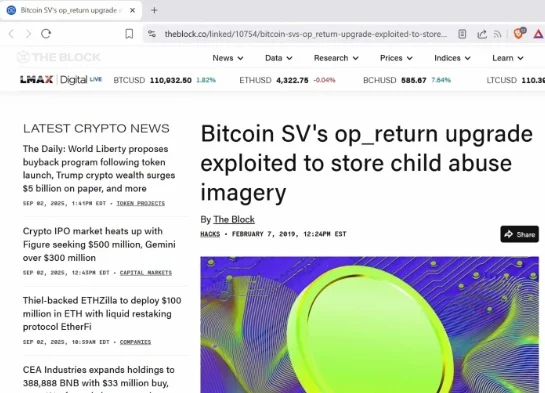

Who Should Use Bitcoin?
- Users prioritizing stricter control over data stored on the blockchain.
- Those seeking lower OP_RETURN limits (40-80 bytes) to restrict arbitrary data.
- Individuals who value configurable mempool filtration capabilities, as offered by implementations like Bitcoin Knots.
- Users concerned about the permanent hosting of illicit material on a blockchain due to immutability.
Who Should Use Bitcoin SV?
- Users requiring a significantly higher OP_RETURN limit (100 kilobytes) for storing extensive data directly on a blockchain.
Side-by-Side Summary
Dimension | Bitcoin | Bitcoin SV |
|---|---|---|
Primary Purpose (Source Context) | Store of value, medium of exchange, hedge against inflation | Blockchain with significantly increased data storage capacity |
OP_RETURN Limit | 40-80 bytes | 100 kilobytes (100,000 bytes) |
Data Filtration | Configurable built-in filter in node implementations | No mention of built-in data filtration |
Illicit Content Risk | Lower risk due to strict limits and filtration | Enabled storage of illicit content due to high limit |
Immutability of Illicit Content | Lower risk of permanent illicit content due to filtering | Illicit content remains permanently hosted |
Notable Node Implementation | Bitcoin Knots (for enhanced filtration) | Not specified in source beyond protocol changes |
Frequently Asked Questions
Is Bitcoin better than Bitcoin SV?
Bitcoin and Bitcoin SV serve different priorities in terms of data storage on their respective blockchains. Bitcoin offers stricter data filtration and lower OP_RETURN limits, which may be preferred by users concerned about arbitrary or illicit content being stored. Bitcoin SV offers a significantly higher OP_RETURN limit for those who prioritize extensive data storage capacity directly on the blockchain.
Which is safer — Bitcoin or Bitcoin SV?
In terms of the risk of illicit content being permanently stored on the blockchain, Bitcoin presents a lower risk. Its lower OP_RETURN limit and configurable filtration capabilities help reduce the likelihood of such material appearing. Bitcoin SV's substantially higher OP_RETURN limit has allowed illicit content to be stored and remain permanently hosted due to the blockchain's immutable nature.
Can I use both Bitcoin and Bitcoin SV?
Yes, Bitcoin and Bitcoin SV are distinct blockchain networks and cryptocurrencies. An individual can choose to interact with both, as they operate independently.
What is the OP_RETURN limit on Bitcoin?
The OP_RETURN limit on Bitcoin Core was initially introduced as 40 bytes in 2014 and was later increased to 80 bytes.
What are the implications of Bitcoin SV's OP_RETURN limit?
Bitcoin SV's increased OP_RETURN limit to 100 kilobytes allowed for illicit material, specifically child exploitation content, to be stored on its blockchain. Due to the immutable nature of the Bitcoin SV blockchain, this illegal content remains permanently hosted.